


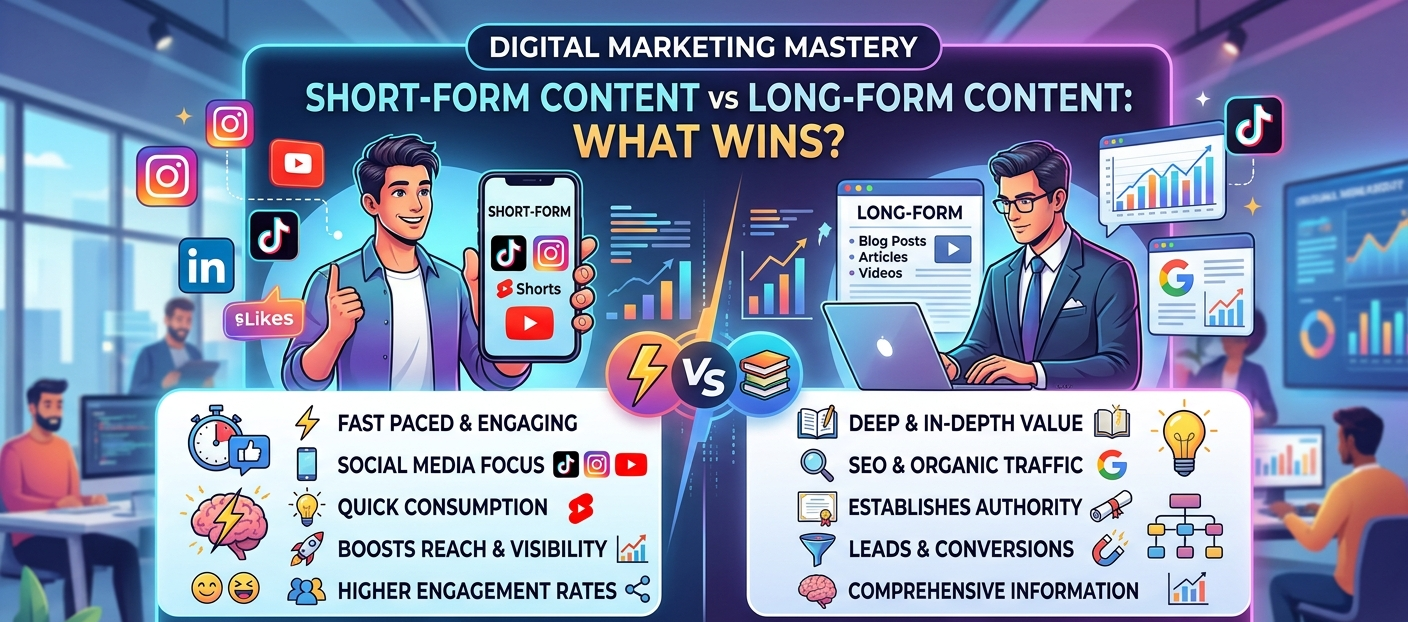
Short-Form Content vs Long-Form Content: What Wins?
Content marketing continues to evolve, and one of the biggest debates for businesses and creators is whether short-form content or long-form content delivers better results. Both formats have strong advantages, but the answer depends largely on goals, audience behaviour, and platform strategy. In fact, Short-Form Content vs Long-Form Content has become a major discussion in modern content strategy. Rather than viewing them as competitors, many brands are learning that both serve different purposes in a successful content strategy.
1. What Is Short-Form Content?
Short-form content refers to quick, easily consumable content designed to capture attention fast. This includes social media posts, short videos, email snippets, reels, and brief blog content. Its biggest strength is engagement. In a fast-scrolling digital world, short-form content performs well because audiences often prefer content that is quick, simple, and easy to consume.
Short-form content is highly effective for increasing reach, building awareness, and driving social engagement. It works especially well on platforms where attention spans are short and content competition is high. Brands use it to grab attention, deliver quick value, and stay visible consistently.
2. What Is Long-Form Content?
Long-form content includes detailed blog posts, guides, case studies, whitepapers, and in-depth videos. Its strength lies in depth and authority. Long-form content allows businesses to educate audiences, answer questions thoroughly, and build trust through valuable information.
It also plays a major role in search engine optimization. Well-structured long-form content often performs strongly in organic search because it can target keywords, improve time on page, and provide deeper relevance for user intent.
3. Where Short-Form Content Wins
Short-form content often wins when the goal is visibility and engagement. It is ideal for attracting attention, boosting social media performance, and generating fast interactions. It is easier to produce consistently and can help brands stay active across multiple channels.
For audiences seeking quick answers or entertainment, short-form content often performs better because it aligns with current consumption habits.
4. Where Long-Form Content Wins
Long-form content tends to win when the goal is education, trust-building, and organic traffic. It allows businesses to demonstrate expertise, address complex topics, and support decision-making for potential customers.
It is especially effective for lead generation, thought leadership, and building long-term content assets that continue generating traffic over time.
5. What Actually Wins? Strategy Wins
The real answer is that neither format universally beats the other. What wins is using the right format for the right objective. Short-form content may attract attention, while long-form content nurtures interest and builds authority.
Many successful brands use short-form content to drive traffic toward long-form content. For example, a short social video may spark interest, while a detailed blog provides the deeper information needed to convert a visitor into a customer.
6. The Future Is Integrated Content
Content strategy is increasingly moving toward integration rather than choosing one format over the other. Businesses are repurposing long-form content into short-form clips, social posts, and snippets, maximizing reach while maintaining depth.
This approach allows brands to benefit from both engagement and authority instead of limiting themselves to one format.
Conclusion
The debate around Short-Form Content vs Long-Form Content is not really about which one wins overall. Each serves a different purpose. Short-form content wins attention, while long-form content often wins trust and long-term value. The strongest content strategies use both together. In today’s digital landscape, the real winner is not short-form or long-form content alone, but a balanced strategy that uses both effectively.